3898. Find the Degree of Each Vertex
We sum each row of the adjacency matrix to read off every vertex's degree in one pass. The row-sum-equals-degree identity is a handy shortcut to pocket for graph problems.
Problem
You are given a 2D integer array matrix of size n x n representing the adjacency matrix of an undirected graph with n vertices labeled from 0 to n - 1.
matrix[i][j] = 1indicates that there is an edge between verticesiandj.matrix[i][j] = 0indicates that there is no edge between verticesiandj.
The degree of a vertex is the number of edges connected to it.
Return an integer array ans of size n where ans[i] represents the degree of vertex i.
Constraints:
1 <= n == matrix.length == matrix[i].length <= 100matrix[i][i] == 0matrix[i][j]is either0or1matrix[i][j] == matrix[j][i]
Examples:
matrix = [[0,1,0],[1,0,0],[0,0,0]]→[1,1,0]. Vertices0and1are connected to each other, vertex2is isolated.matrix = [[0]]→[0]. A single vertex with no edges.
Walkthrough
Loop and count
Given that each row of the matrix has a 1 if there is an edge, to find out how many edges there are connecting to any given row, it is simply the number of 1's in that row.
We can walk each row, count the entries equal to 1 with an if check, and append that count to the result.
1 2 3 4 5 6 7 8 9 10 | |
This is O(n^2) as the matrix is of size n x n and we loop through every element in it. We can't really do better than that on the time front: the input itself has n^2 entries and we have to look at all of them at least once to know if there's an edge.
The memory requirement is O(n) as we create a new output array of size n. That's also the lower bound, since the answer itself is n numbers long.
List comprehension
As the absence of an edge is a zero then the count of the number of ones is the same as the sum of the row. We don't need the explicit counter or the if check at all, just sum(row).
This means we can do this with a simple list comprehension. This is much more like the python code you'll actually find people writing.
1 2 3 | |
Submission result
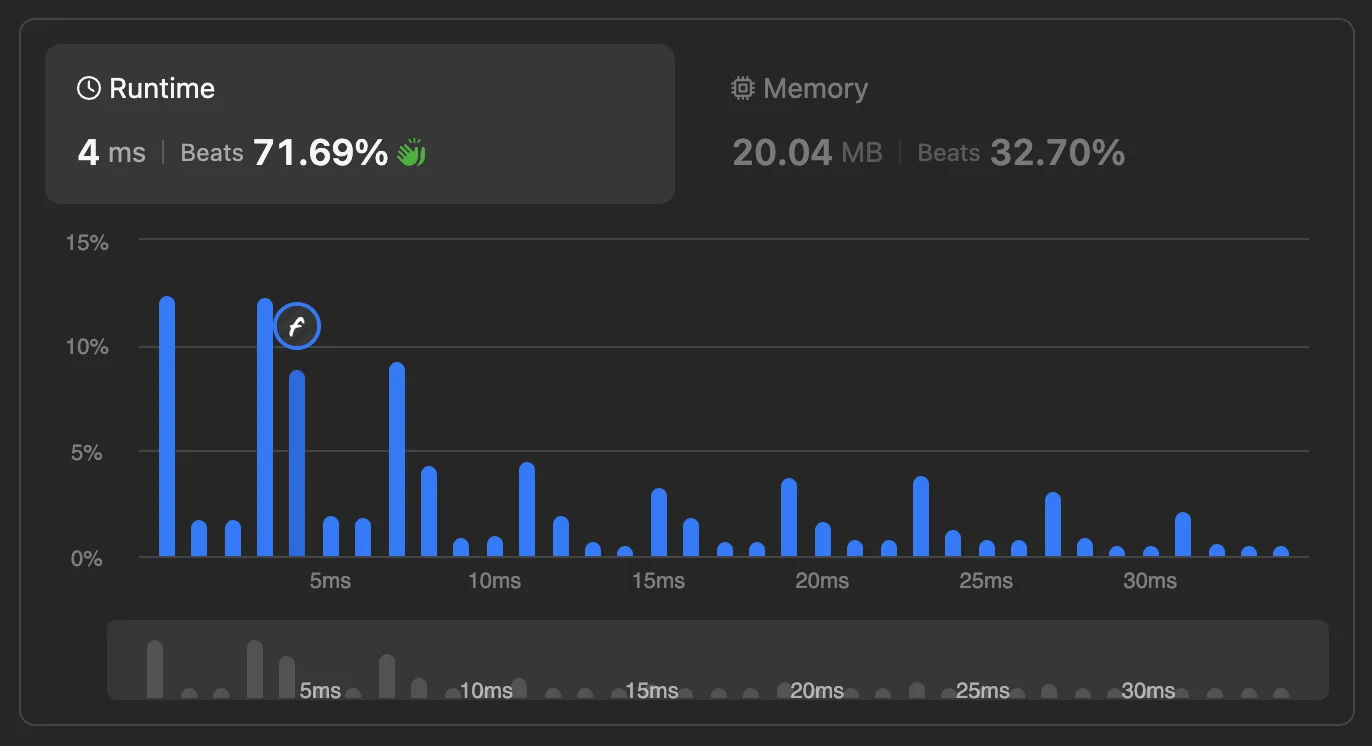
Same O(n^2) time and O(n) memory as before, just much shorter to read.
In-place
We could go a step further and avoid that extra n memory entirely by overwriting each row of the matrix with its sum.
1 2 3 4 5 | |
Submission result
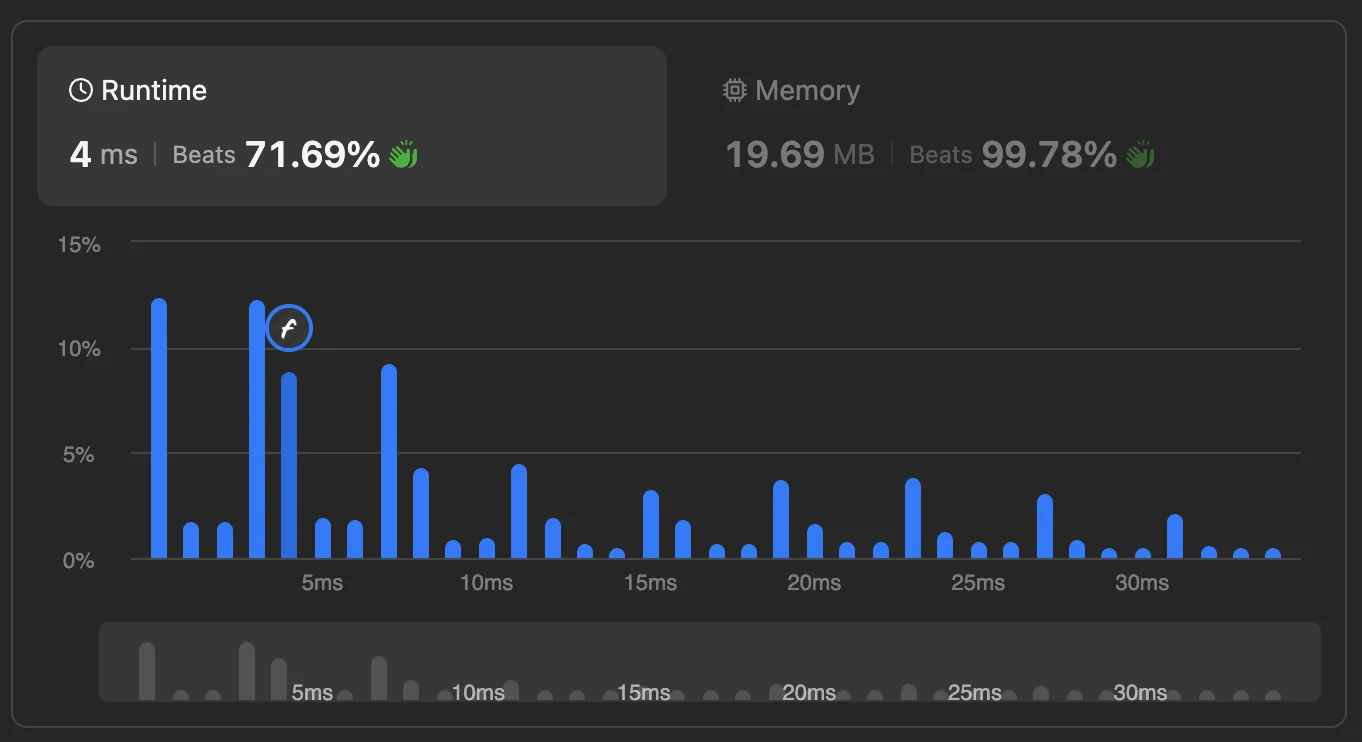
This drops us to O(1) extra memory, but it's destructive to the input. The caller can no longer use matrix as an adjacency matrix afterwards. In an interview I'd mention this as a trade-off rather than reach for it by default. The constant-factor memory saving usually isn't worth losing the input data, especially when the matrix might still be needed for other queries.