3903. Smallest Stable Index I
We iterate from a brute-force scan to a two-pass sweep that precomputes a right-min array and walks a running left-max. The "precompute one side, sweep the other" pattern crops up everywhere.
Problem
You are given an integer array nums of length n and an integer k.
For each index i, define its instability score as max(nums[0..i]) - min(nums[i..n - 1]).
In other words:
- max(nums[0..i]) is the largest value among the elements from index 0 to index i.
- min(nums[i..n - 1]) is the smallest value among the elements from index i to index n - 1.
An index i is called stable if its instability score is less than or equal to k.
Return the smallest stable index. If no such index exists, return -1.
Constraints:
1 <= nums.length <= 1000 <= nums[i] <= 1090 <= k <= 109
Examples:
nums = [5, 0, 1, 4], k = 3→3. Instability scores are5, 5, 4, 1; index3is the first ≤3.nums = [3, 2, 1], k = 1→-1. Every index scores2, never ≤1.nums = [0], k = 0→0. The only index scores0, which is ≤0.
Walkthrough
Observations
The first thing I pick up on here is that you use the index you're at in both the lookup to the left and the right, that's easy to overlook.
The next note is that the question is asking for the smallest stable index. Which means if we're processing the list from left to right we can stop as soon as we find one.
Brute force
As always it can be useful to implement the obvious answer first. We can simply iterate through every element, calculating the max values to the left and the min to the right each time.
1 2 3 4 5 6 7 8 9 | |
Submission result
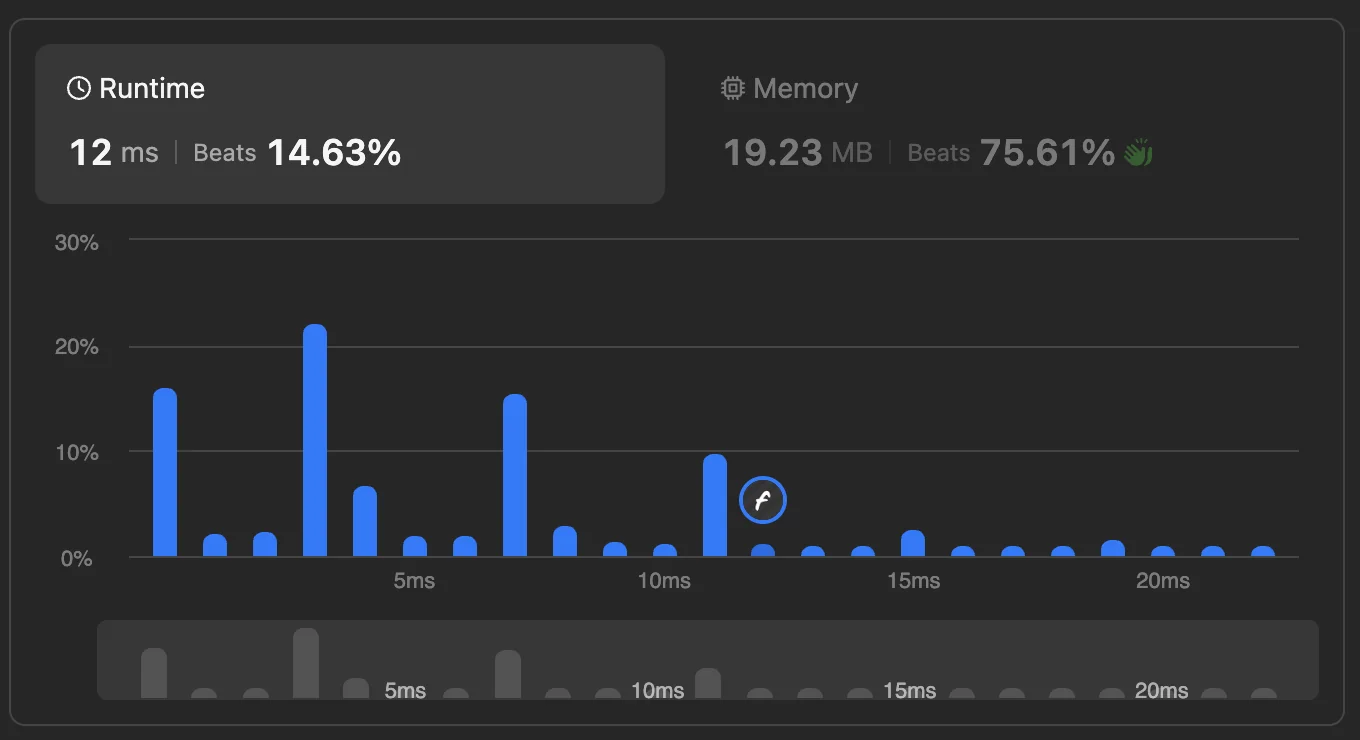
The main thing to note here is that the list slice for the left elements must be idx + 1 so it includes the value at nums[i].
Every iteration through the nums array we check every number, which means if there are n elements in the list we're doing n * n operations so the complexity of this is O(n^2).
Max-optimisation
Each time we iterate the nums array we calculate the max. However, the max can easily be computed taking the previous max and the new value. If that new value is bigger - that's the new max.
This will stop us having to iterate over all the preceding values each time.
1 2 3 4 5 6 7 8 9 10 11 12 13 | |
Submission result
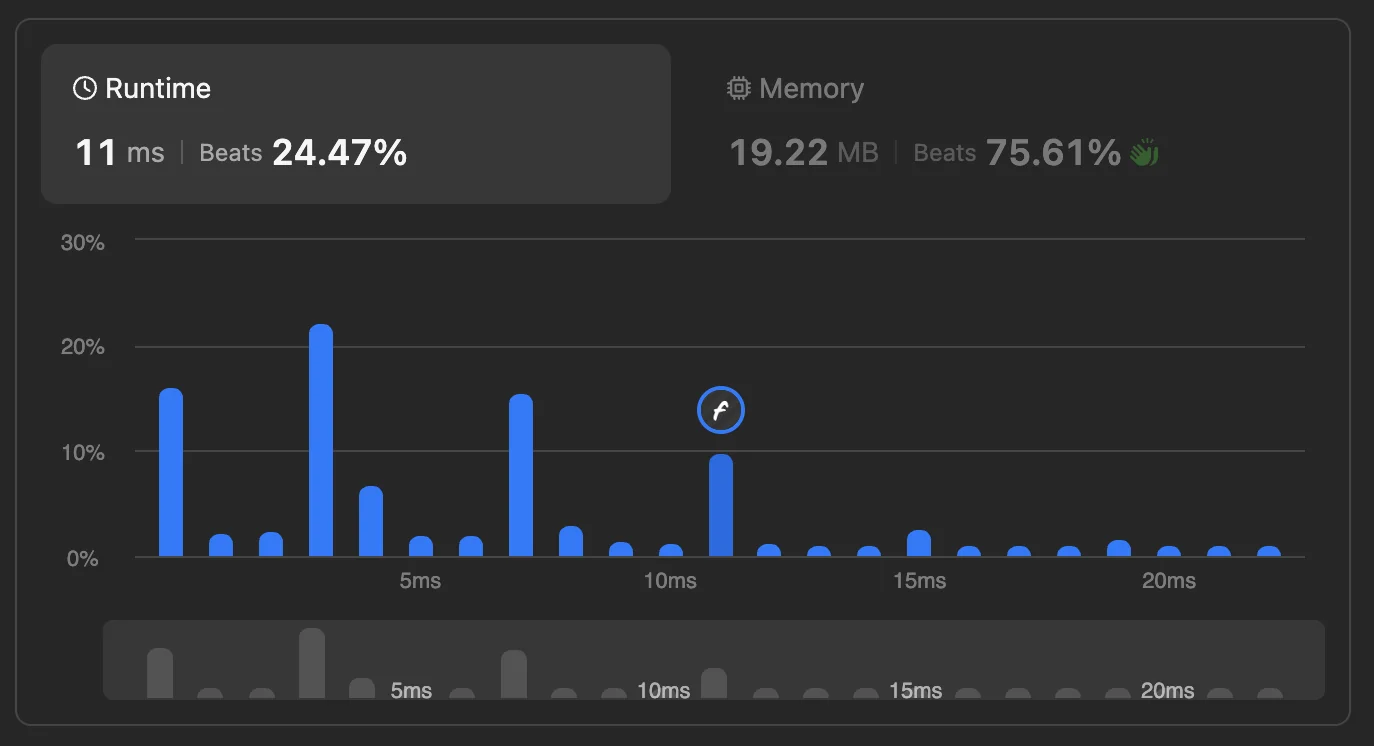
I've updated the left_max using max(left_max, value) you could equally have written if value > max: left_max = value if that's more intuitive for you.
This cuts down on half of the comparisons we need to do within the loop to n / 2. However, the number of operations is still n * (n / 2) which is O(n^2). So, whilst we've improved the leading constant we've still got a complexity that scales with the square of the length of the array.
Counter
Can we then do something similar with min? We can't use exactly the same trick as with the max because this time the list will start full and we'll be taking items away each time. If the array is [1, 3, 1] then the min is 1, but when we remove the next 1 it's still 1. Whereas that isn't true with [1, 3, 2]. You need to know if that was the last minimum you've removed in order to update it.
To follow this logic we could then use a counter to help track how many of each value there is on the right side. When the counter for the minimum element equals 0 we update the minimum. We're still going to have to do a min over a list but it'll be the list of unique values which generally would be lower. The edge case of [1,2,3,4] would be the worst where each time we remove the min. Let's work this one through anyway:
1 2 3 4 5 6 7 8 9 10 11 12 13 14 15 16 17 18 19 20 21 22 23 24 25 26 27 | |
Submission result
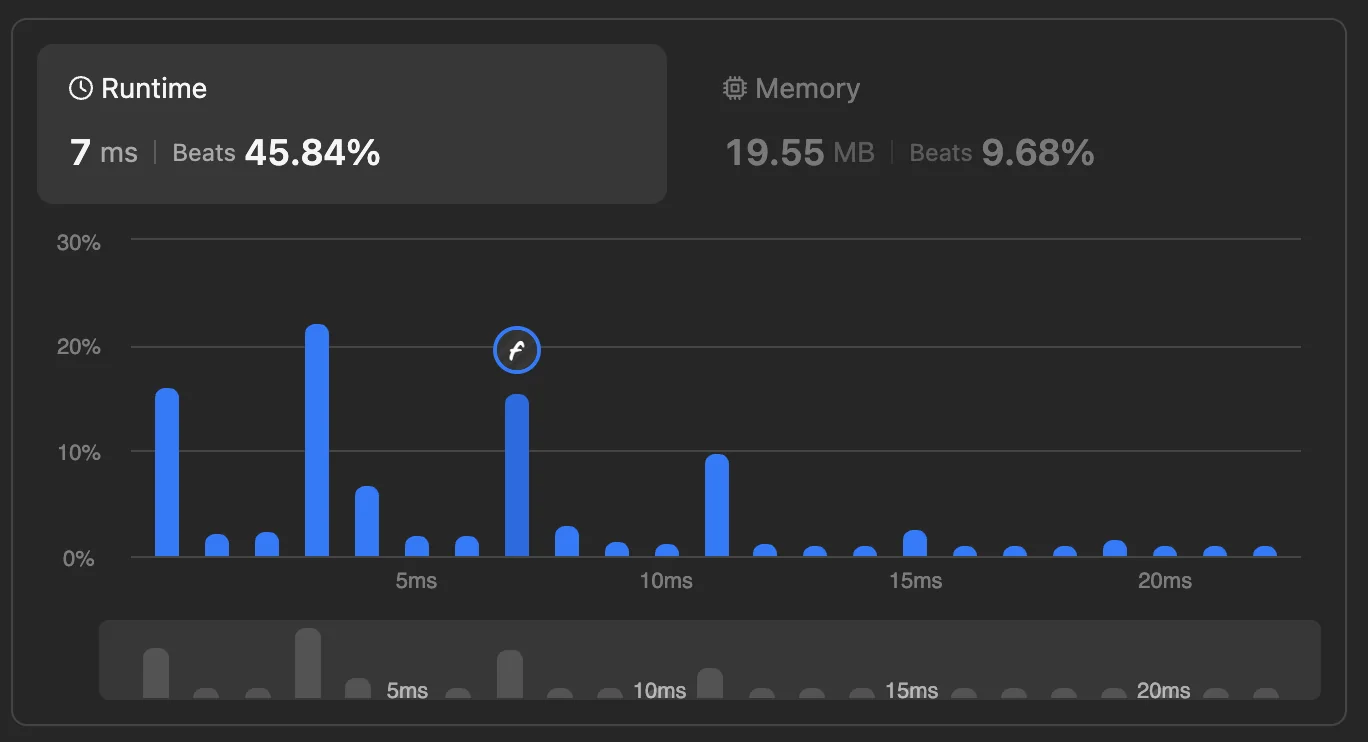
This is still O(n^2) in the worst case - imagine [1,2,3,4] where every step removes the current min and we have to recompute it from the remaining unique values. The average case is much better though, as we only pay for the min recomputation when we actually drop the current minimum entirely.
Step back
Now if you have been having the same thoughts as I've been outlining here then there are two paths you can take from this point. The first is that you power on - you can clearly see a way forward and if only you ordered the list of minimums you'd not need to do that min and you can finally get it to O(n)... but wait sorting is O(n log n) so even that wouldn't work. etc. etc.
This code is already complex now, bolting on optimisations is only going to make it more so. You have to realise when it's best to abandon a solution and not submit to the sunk-cost fallacy.
Let's go all the way back to the beginning. Hopefully, by now you have a good understanding of what the problem is asking. Maybe, we can reframe the problem in a better light.
As we progress through the list the max value is strictly increasing - it has to be, it's the max. But the min value we see will also be strictly increasing. At the start it's the whole list so it's the global minimum, then as we lose values from the list we'll likely lose this and it'll go up.
Rather than operating on the actual list of numbers we can create copies of this list we'll adapt. We'll use more memory, but we'll get the runtime down. So, what do we want in these list. Obviously, the best place to start is the minimum and maximum values at each point in the list!
If we do one pass from left to right we just record the max up to that point so [1,4,3,6,2] becomes [1,4,4,6,6]. We can do the same thing going from right to left to calculate the minimum, our same list becomes: [1,2,2,2,2]. Now we can simply go over both from left to right calculating the instability score using the pre-computed values!
1 2 3 4 5 6 7 8 9 10 11 12 13 14 15 16 17 18 19 20 21 22 23 24 25 26 | |
Submission result
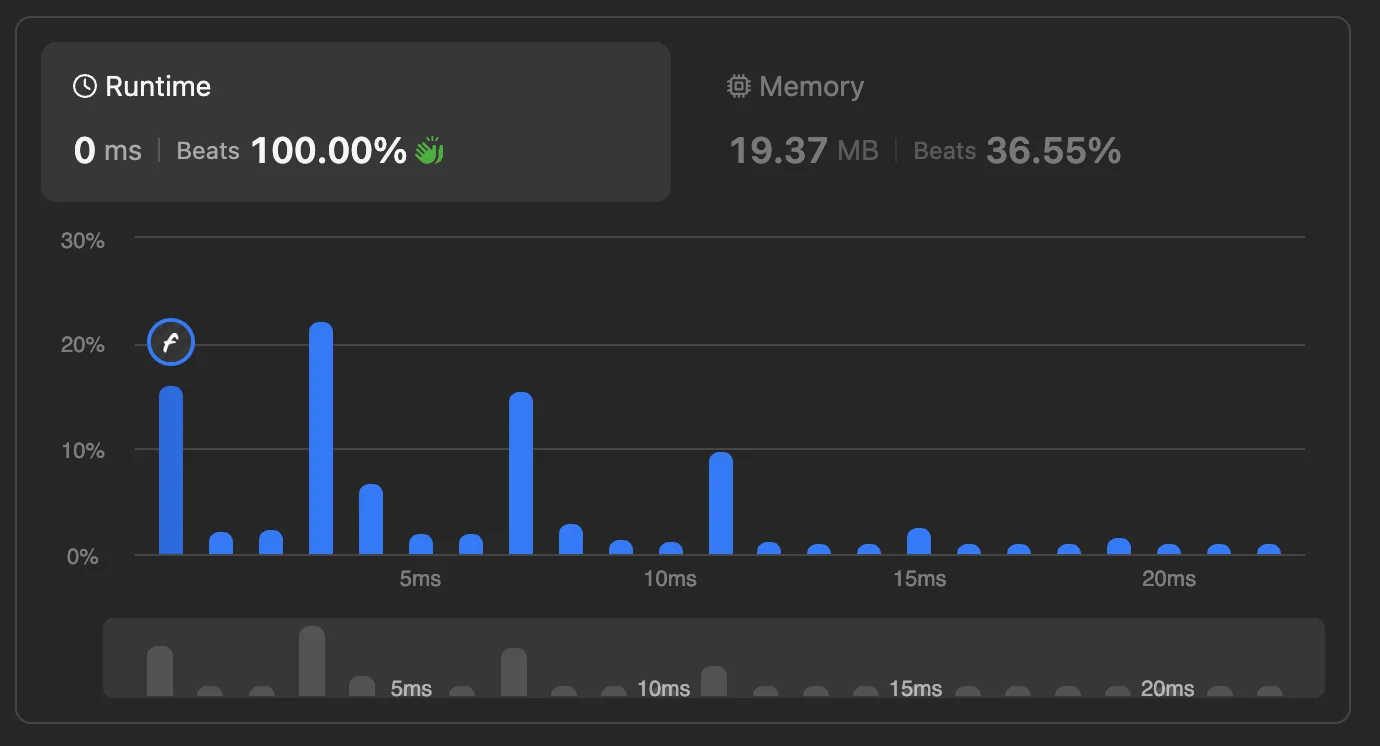
This is much better, we're now firmly at O(n) complexity as we're just iterating over the loop 3 times. Noting that we need to keep two extra copies of the array in memory.
Optimal
We can go one step further here and remove one of those pre-computed lists. Since we do our final iteration left-to-right looking for our solution we can compute the max as we're going along just like we did originally. So we can apply our original optimisation to this solution too! Well done if you remember that straight away.
1 2 3 4 5 6 7 8 9 10 11 12 13 14 15 16 17 18 19 20 21 22 23 24 | |
Submission result

So that's our best solution at O(n) using just two passes of the data, and 1 extra copy of it.